Evidence that chronic disease is caused by pathogens
The mainstream, but antiquated, view about chronic disease is best expressed by a certain physician thusly: “Of our thousand bacterial species, I only have to worry about a couple dozen” while a 2002 Nature paper concludes, “Multicellular organisms live, by and large, harmoniously with microbes.1)
However, there is substantial evidence that chronic diseases are caused by pathogens as opposed to other causes. This evidence includes:
-
familial aggregation of disease and incidence in small communities in close contact
migration studies
single region changes in incidence
transmission of disease through blood and tissue donation
-
In addition, it seems highly likely that supposedly non-infectious chronic diseases are in fact caused by pathogens when one considers their clinical features, histology, treatment response, microbe populations, presence of co-infections, the ease with which co-infections proliferate, and the failure of systematic lifestyle interventions.
According to the Marshall Pathogenesis, humans accumulate a plethora of pathogenic bacteria during their lifetimes, and it is the genetic mutations which result from active infection that play a major role in what is commonly thought of as “genetic susceptibility.”
Besides the absence of proof implicating human genes as the major causative factor, there is a range of evidence - including strong epidemiological and compelling evolutionary evidence - suggesting that pathogens cause chronic diseases.
Epidemiological evidence
Epidemiological evidence including case clustering in time or location supports a pathogenic cause for disease.
Early acute infections predispose a person to chronic disease – Patients who get acute infections are more like to get chronic disease. O'Connor and team at the Centers for Disease Control and Prevention state, “At least 13 of 39 recently described infectious agents induce chronic syndromes.”
2) For example, fully 10% of people who suffered from
E. coli food poisoning later developed a relatively infrequent life-threatening complication called hemolytic uremic syndrome (HUS) where their kidneys and other organs fail.
3) Approximately two-thirds of patients with Guillain-Barre syndrome, a suspected autoimmune syndrome, have a history of an antecedent respiratory tract or gastrointestinal infection.
4) Campylobacter infection is the most commonly identified precipitant of GBS and can be demonstrated in as many as 30 percent of cases.
5) Reactive arthritis (Reiter's syndrome) is another excellent example. Reactive arthritis is classically seen following infection with enteric pathogens such as
Yersinia, Salmonella, Campylobacter and
Shigella.
6) In a 2006 study, Alan S. Brown of Columbia University showed that prenatal infections such as rubella, influenza, and toxoplasmosis are all associated with higher incidence of schizophrenia.
7) Brown found a seven-fold increased risk of schizophrenia when mothers were exposed to influenza in the first trimester of gestation. One final example: a 2010 study concluded that cesarean delivery is associated with 1.8 times higher risk of celiac disease but not inflammatory bowel disease in children.
8)
Familial aggregation of the same disease – A number of studies have shown that spouses have a greater chance of developing the same disease as their partners - a phenomenon that can best be explained if familial aggregation has an infectious cause. One study of sarcoidosis found that among the 215 study participants who had been diagnosed with sarcoidosis, there were five husband-and-wife couples that both had the disease, an incidence 1,000 times greater than could be expected by chance.
9) In another study, British researchers found that men whose spouses had hypertension had a two-fold increased risk of hypertension. Similarly, women whose spouses had hypertension also doubled their risk of developing the disease. The risk for both male and female subjects
persisted after adjustment for other variables such as diet.
10)
Familial aggregation of different diseases – Research suggests that seemingly distinct diseases have a
common underlying disease process, namely infection with different forms and species of chronic bacteria. For example, a 2008 study of parents of children with autism found they were more likely to have been hospitalized for a mental disorder than parents of control subjects. Schizophrenia was more common among case mothers and fathers compared with respective control parents.
11)
Disease prevalence of small communities in close contact – A number of studies of unrelated people shows that mere proximity seems to be enough to transmit chronic disease. A case-controlled study of residents of the Isle of Man found that 40 percent of people with sarcoidosis had been in contact with a person known to have the disease, compared with 1 to 2 percent of the control subjects.
12) Another study reported three cases of sarcoidosis among ten firefighters who apprenticed together.
13) A cluster of 13 cases of Parkinson's disease among a community of 592 people were reported in Israel, significantly more that would be expected by chance.
14) Research suggests that obesity is also an inflammatory disease caused by certain species of the Th1 pathogens. A study recently published in the
New England Journal of Medicine found that a person’s risk of becoming obese increases by 57% if they have a friend who becomes obese, and by 37% if their spouse becomes obese.
15) According to the researchers: “These clusters did not appear to be solely attributable to the selective formation of social ties among obese persons.”
Migration studies – Many published migrant studies have shown that incidence of chronic disease, specifically cancer, changes on migration, pointing to a predominant environmental contribution to cancer causation.
16) 17) 18) One study of people immigrating to Sweden found that they had increase prevalence of cancer particularly lung cancer.
19)
Comorbidities with other inflammatory conditions – According to numerous observational studies, patients suffering from a given chronic inflammatory disease are significantly more likely to have or get additional diseases. In
her speech at the International Congress of Autoimmunity, Amy Proal reported that of the Marshall Protocol subjects with Hashimoto's thyroiditis who participated in a survey, only 8% with Hashimoto's had Hashimoto's alone; the Hashimoto's patients had at least one, sometimes several comorbidities. This phenomenon has yet to be satisfactorily explained by those failing to invoke a pathogen-driven explanation, which would account for bacteria spreading throughout the body and causing different disease manifestations. At the very least, the frequent difficulty doctors have in clearly and definitively diagnosing a patient with multiple, ill-defined, and overlapping conditions suggests all inflammatory diseases possess some kind of shared and underlying pathology.
Single region changes in incidence - A number of regions have seen strong changes in the incidence of cancer, strongly suggesting an environmental cause for disease. For example, during the operation of the
Swedish Cancer Registry, from 1958 to 2003, the incidence of male melanoma increased 7.7-fold, squamous-cell skin cancer increased 4.1-fold, prostate cancer and non-Hodgkin lymphoma both increased 3.2-fold, and breast cancer increased 2.2-fold. At the same time, the incidence of male gastric cancer decreased 3.4-fold.
20) Such changes can also be found in other registration systems with long periods of follow up, such as the Connecticut Tumor Registry.
21) In Japan, which is historically a low-risk area for colon cancer, there has been a dramatic increase in the incidence of this disease (some 10-fold in men between 1960 and 1990) according to the Miyagi Cancer Registry.
22) The best explanation for these findings is an increase or decrease in the communication of bacteria causing a certain disease.
Season or month of birth23) – In temperate climates the frequency of late winter and early spring births is generally 5 to 15 percent greater among babies that eventually develop schizophrenia than among controls.
24) This association suggests some seasonal environmental influence, such as exposure to infectious agents, which often peaks during winter months. The association was not found in Singapore, where distinct warm and cold seasons are absent.
25) Another statistically significant month of birth distribution was found for patients who suffer from
Graves' disease and Hashimoto's thyroiditis, which are collectively known as autoimmune thyroiditis.
26)
Other evidence
There is also the following types of evidence, the first three of which are noted in a 1998 article and 200527) paper by David Relman and David Fredricks:
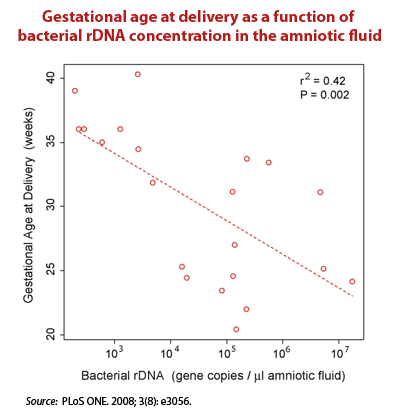
Newer cultivation techniques have associated bacterial count in a pregnant woman's amniotic fluid with age at delivery. This data strongly suggests a causative role for pathogenic bacteria in premature delivery. Source:
DiGulio et al.
Failure of lifestyle interventions – It has been widely hypothesized that lifestyle factors, including a poor diet and a lack of exercise, are the primary driver behind increased rates of chronic disease. For example, the World Health Organization
has termed “an obesity epidemic,” but even the most ambitious obesity intervention programs, which have gone to great lengths to increase rates of exercise and improve eating habits of a population, have been failures. One 1999 $200,000 NIH-funded intervention, known as the Pathways program, was performed on two groups of children. Pathways involved a substantial increase in physical education programs, classes about nutrition, significant reduction in fat and calorie content of all school meals, and several other health related measures - and all as part of a randomized controlled trial, the gold standard in studies. The primary goal of the study was to reduce the rate of body fat in the intervention group, but after the three-year intervention the percent of body fat in both groups was essentially identical. The researchers were unable to explain the failure of their intervention.
37) Other such trials for obesity have been equally unsuccessful.
38)
-
Disease appearing in tattoos – Over the last 40 years, there have been numerous reports of patients developing skin cancer in their tattoos including melanoma, basal cell carcinomas, squamous cell carcinomas, and keratoacanthomas.
42) Also, the literature contains multiple reports of sarcoidosis patients developing skin lesions within tattoos. According to one researcher, this is “a well-recognized occurrence in patients with sarcoidosis.”
43) That a tattoo procedure could induce this kind of reaction strongly suggests that diseases such as cancer and sarcoidosis are caused by the introduction of infectious pathogens through contaminated needles.
Disease appearing in scars – There are several case reports of sarcoidosis lesions forming within scars, which are especially susceptible to infection. That these granuloma often take long periods of time to be realized corresponds with the growth rate of the slow-growing chronic pathogens which the Marshall Pathogenesis implicates in chronic disease.
44) According to one report, a patient developed sarcoid granuloma fully 50 years after his initial injury.
45) Sorabee
et al write that in addition to reactivation of scars obtained from previous wounds
46), scar sarcoidosis has been reported at the sites of previous intramuscular injections, blood donation venepuncture sites, scars of herpes zoster,
47) sarcoidosis on ritual scarification,
48) and at the sites of allergen extracts for desensitisation.
49)
Absence of an effect for most chemicals thought to be toxic – In contrast to infectious agents, little evidence implicates typical doses of dietary chemicals as primary causes of human cancer. Paul Ewald, PhD has concluded that humans have evolved effective flexible enzymatic systems for degrading potentially carcinogenic chemicals.
50) Even aflatoxins, which are one of the most carcinogenic of dietary constituents, may exert their negative effects largely in conjunction with viral infection.
51)
Difficulty distinguishing autoimmune disease from infectious disease – Although they have identified a signature that distinguishes healthy individuals from sarcoidosis or tuberculosis patients, the biosignatures of both diseases are nevertheless very similar. According to the
Max Planck Institute, it is almost impossible to distinguish between tuberculosis and sarcoidosis with just a single signature. A set of different biosignatures is better suited for distinguishing in a first step between diseased and healthy individuals and, in a further step, between the specific diseases.
Evolutionary evidence
One useful way to determine if a disease is caused by faulty human genes is look towards the central principle of evolutionary biology: evolutionary fitness. Evolutionary fitness is defined as the extent to which an organism is adapted to or able to produce offspring in a particular environment. The fitness concept can be applied to the problem of disease causation to distinguish evolutionarily feasible hypotheses of causation from marginally feasible or untenable ones.52) 53)
If the common inflammatory diseases (including autoimmune diseases) were genetic, the only way they would manage not to be weeded out of the population would be if they conferred some sort of beneficial survival trait not related to the disease.
To date, no such benefits have been identified in any chronic disease, schizophrenia being a good example.54) Schizophrenics have a high suicide rate, few children, and a high rate of abnormality in their children.55) 56) Schizophrenic mothers are more likely than non-schizophrenics to have stillborn babies and children with congenital malformations.57) This would mean schizophrenic mothers and fathers would be less likely to pass on a theoretical schizophrenic gene to their offspring. On the contrary, incidence of the disease is only escalating suggesting that bacteria are passed from generation to generation.
Motive and opportunity
Biology and law typically don't have much in common, but one useful metaphor for considering the validity of a proposed pathogenesis for chronic disease is to compare the search for the cause of disease to that of a trial for homicide. Two key pieces of evidence in any such trial are opportunity and motive. Basically, could the defendant have done it, and was it in his interests to do so?
Bacteria have both motive and opportunity.
Unlike toxins, environmental causes, human genetics or many of the other major proposed causes for chronic disease, bacteria are driven by a biological imperative, namely the evolutionary impetus to promote their genes through aggressive reproduction. Of course, the same cannot be said for other potential causes, especially human genes. In fact, it's decidedly in the interests of humans not to pass on genes, which limit reproductive fitness, in some cases drastically so.
<html><!–
The Vitamin D Receptor (VDR) is at the heart of innate immunity and transcribes thousands of genes.58) Given that the VDR can be inactivated by ligands bacteria are known to create and the fact that 90% of cells in the human body are bacterial, bacteria certainly have the opportunity to cause disease as well.
Some, as a matter of principle, take issue with the MP's “one size fits all” explanation of the pathogenesis of disease. Not to mix metaphors, but bacteria's ability to subvert the VDR is the equivalent of a widespread and easy-to-exploit flaw in a widely distributed operating system for computers. The VDR is evidently quite powerful, by one count coding for over 27,000 human genes59). So, it's not as if humans can evolve itself an alternative in the near term.
Versatile thought it is, the VDR has an enormous vulnerability, one which every species of pathogenic bacteria can take advantage. Can and do software bugs happen on an equivalent scale to that of chronic disease? Absolutely. With scarce resources, why would a group of bacteria engineer an alternate “exploit” if this method for facilitating survival has been working so well for millenia?
–></html>
===== Notes and comments =====
Pathogenicity is, in a sense, a highly skilled trade, and only a tiny minority of all the numberless tons of microbes on the earth has ever involved itself in it; most bacteria are busy with their own business, browsing and recycling the rest of life. Indeed, pathogenicity often seems to me a sort of biological accident in which signals are misdirected by the microbe or misinterpreted by the host.—Lewis Thomas, The Medusa and the Snail
Sterile in health
Characteristic of medically important bacteria's outer surface is a rigid cell wall containing peptidoglycan
–Review of Medical Microbiology and Immunology, 2008
===== References =====
